Generation Trapped - Centre for Independent Studies Research
Spectre’s research for the Centre for Independent Studies explores how young Australians think about their lives, aspirations, and future prospects. Using a large quantitative sample of young voters, the findings highlight an enormous disconnect between young people’s aspirations and goals, and what they believe is now realistically achievable.
Young Australian’s life goals remain familiar, financial security, home ownership, family, and meaningful work. However, the pathway to achieving them is increasingly perceived as unattainable or blocked. The result goes beyond economic pressure, with a substantive sociological shift: declining life satisfaction, rising anxiety, and above all a weakening sense of personal agency tightly correlated to both.
While some themes are shared in common among young Australians, their approaches, mindset, and values vary substantially in facing a similar suite of issues. With this in mind Spectre segmented young Australians into six distinct ‘tribes’, each with their own unique characteristics. Below are the descriptions of each as described by CIS author Parnell Palme McGuinness:
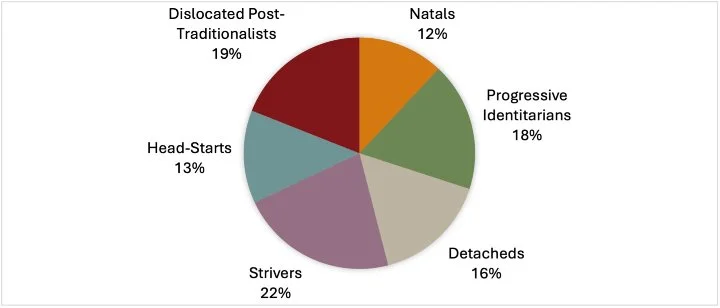
Progressive Identitarians
This group is committed to far-left progressive ideas and identifies as LGBTQ+ at much higher than average rates. They are disproportionally likely to be students, still living with parents or renting. They have given up on traditional goals such as home ownership and children, and focus instead on short-term fulfilment. They are highly politicised, anxious, and pessimistic, with low perceived agency and strong support for redistributive government action.
Dislocated Post-Traditionalists
This group are predominantly women with a low level of educational attainment. They tend to have children but be unmarried, identifying their relationship status as de-facto. They are economically anxious, anti-establishment, and exhibit the lowest life satisfaction and sense of control of all the tribes.
Natals
This group is predominantly male with a slightly lower than average educational attainment. They value traditional milestones but feel systematically blocked from achieving them. They are nationalist, anti-immigration, and deeply sceptical of government and institutions. They have a low sense of control and life satisfaction.
Strivers
This group aspires to traditional milestones and takes a pragmatic and hopeful approach to achieving them through hard work and application. But they are concerned that these milestones have become more difficult to achieve. They have a moderate sense of personal control and corresponding life satisfaction, but they may be at risk of becoming frustrated and losing their drive and sense of agency if their hard work doesn’t pay off.
Detacheds
This group is disengaged and optimistic by default, with weak forward planning and fragile foundations for future life satisfaction. They tend to be single but wish to be in a relationship. They have a ‘she’ll be right’ attitude which — while not exactly a sense of control — is connected to a moderate sense of life satisfaction.
Head-Starts
This group is affluent, likely to already own a home, and be married with children. They have already received, or expect to benefit from, family wealth transfer. They have a very high sense of autonomy and personal control, and strong life satisfaction. They regard institutions and government favourably and with trust, as they see them as having contributed to their success in life.
Read the full report here: https://www.cis.org.au/publication/generation-trapped-housing-handouts-and-the-collapse-of-young-australians-life-satisfaction/
Snapshot Report: https://www.cis.org.au/wp-content/uploads/2026/03/RR52-snapshot.pdf
